


The
Calm Creative


Texture Art for Beginners: Your First Art Piece
I Told Myself I Wasn’t Artistic for 40 Years. One Afternoon Changed That.
For most of my adult life, I had a quiet belief: art was for other people.
Now, I love to be creative. But after two decades in corporate sales, I became more comfortable with a spreadsheet than the aisles of Michaels. But I found myself watching artists from a careful distance, quietly admiring what they could do, never considering that the distance was optional.
If you’ve ever looked at a painting, a real one, the kind with texture and dimension and something that pulls you in and felt a little tug followed immediately by the thought “I could never do that,” this post is for you. Because texture art for beginners isn’t a watered-down version of something hard. It’s an entry point that doesn’t require talent, background, or a single artistic bone in your body. It requires curiosity. That’s all.
Table of Contents
- The Story We’ve All Told Ourselves
- What Changes When You Pick Up a Palette Knife
- Why Texture Art Is Different From Everything Else You’ve Tried
- What Actually Stops Beginners (It’s Not What You Think)
- What Your First Piece Does to You
- Where to Start
The Story We’ve All Told Ourselves
There’s a moment it usually happens. For me, it was a 5th grade art camp. We were told to sketch a magnolia then paint it with watercolors, a technique I had never tried. I labored over it and was so proud when it finally was complete. The feeling was a kind of pure, unguarded pride that kids have before they know they’re being judged. Then it came, the critique from the teacher that was well intentioned but hit hard for my young brain. From there a small story gets written.
I’m not artistic.
It’s such a small sentence. But it follows a lot of us for decades. It becomes the reason we don’t try things, don’t sign up for classes, scroll past the art supply aisle without stopping. It becomes an identity instead of a moment.
But it doesn’t have to be that way.
Not because everyone is secretly an artist waiting to come to life. But because the sentence “I’m not artistic” gets applied to things that have nothing to do with natural talent, things like technique, which is learnable, and permission, which you can give yourself any time you want.
What Changes When You Pick Up a Palette Knife
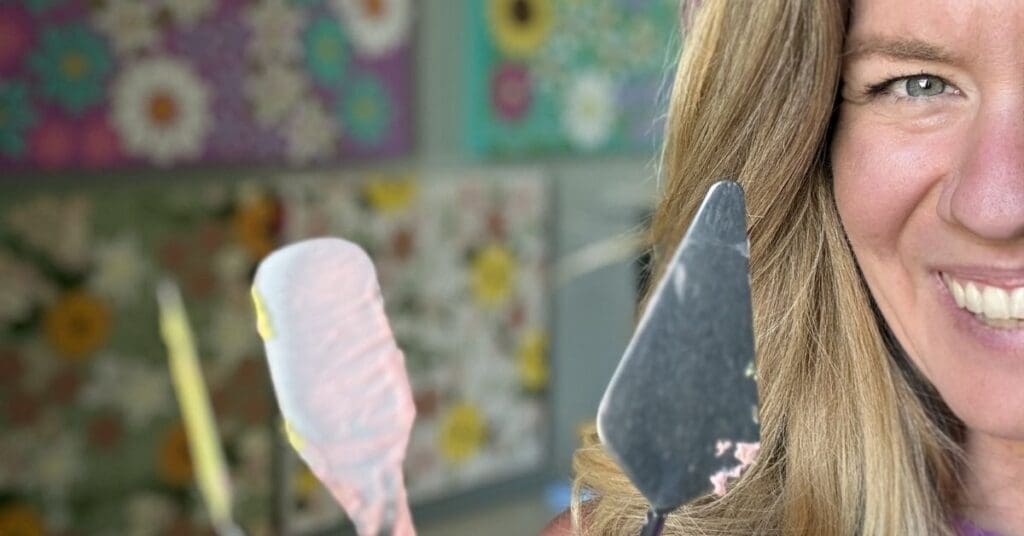
I want to tell you something that surprised me the first time I picked up a palette knife: it felt like permission.
Not permission from anyone else. Permission from myself to make something without being good at it first.
The palette knife is not a precision tool. It doesn’t demand steadiness or fine motor control or years of study. It’s actually forgiving in ways a brush is not. You load it with textured, a mix of light modeling paste and acrylic, and you move it across the canvas with intention. Sometimes the stroke goes exactly where you planned. Sometimes it does something better than you planned.
That unpredictability is the point. It makes every piece slightly different. It makes “mistakes” look like decisions. It removes the pressure of perfection before you even start.
I’ve been teaching yoga for over twelve years. One of the things I come back to again and again in that practice is the idea that showing up, even imperfectly, even on a hard day, it is the whole practice. Picking up the palette knife for the first time felt the same way. The act of beginning was the breakthrough.
Why Texture Art Is Different From Everything Else You’ve Tried
Most people who tell me they’ve tried painting and quit say the same thing: it never looked like what they had in their head. The colors got muddy. The lines went wrong. The whole thing ended up in the trash with a quiet sense of confirmation.
Textured floral painting sidesteps most of those failure points for a few specific reasons.
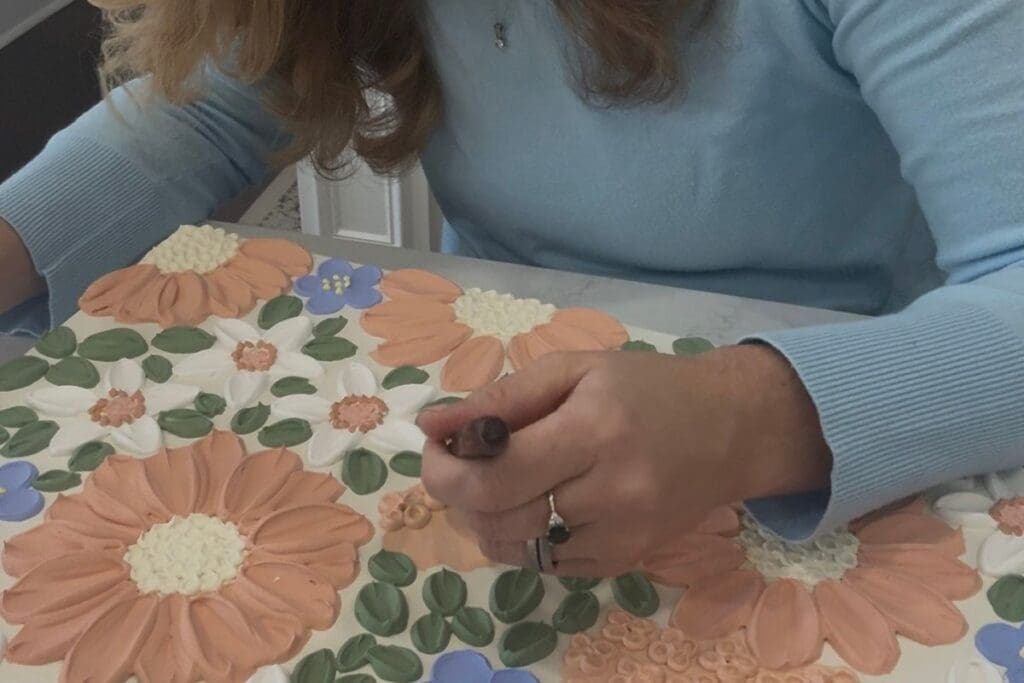
First, the dimension does a lot of the visual work. Your sunflower petals actually lift off the canvas, there is physical depth you can run a finger across and the piece reads as impressive regardless of technical precision. The texture itself creates beauty. You don’t have to earn it through skill you don’t have yet.
Second, the flowers are guided by templates. You’re not staring at a blank canvas trying to figure out where a sunflower center goes, how large to make the petals, whether the proportions look right. The template handles all of that before you pick up a knife.
Third, this technique is fast. A beginner can finish a textured sunflower in ten to fifteen minutes from first stroke to complete piece. You get a finished result, something real, something beautiful, in a single sitting. No multi-session commitment, no drying time between layers, no mounting frustration. Just a finished piece you’re proud of.
That feeling of completion is what keeps people coming back.
Before We Go Further
If you want to try this, the first thing you need is the right supplies and knowing what to buy (and what to skip) makes all the difference between a great first experience and a frustrating one.
I put together a free materials list with everything I actually use: the paste, the knives, the canvas sizes, the paint. It’s the exact starting point I’d hand anyone who’s new to this.
→ Grab the free materials list here
What Actually Stops Beginners (It’s Not What You Think)
Most people assume the thing stopping beginners is skill. That’s almost never what it actually is.
What actually stops people is one of three things.
Not knowing where to start. There are a hundred art tutorials online and they all assume different levels of experience. The overwhelm of sorting through them, figuring out what supplies to buy, what technique to try first, what a “beginner” project actually looks like, stops more people than any lack of talent ever has.
Fear of the blank canvas. There’s something about facing a completely empty surface that triggers the “I’ll mess it up” voice. Templates solve this more completely than most people expect. When you already have light pencil marks showing you where the flower goes, the blank canvas stops being a threat.
The expectation of immediate perfection. We’ve all watched sixty-second art videos where a completed masterpiece appears in under a minute. The truth is your first piece will be good. It won’t be your best. It doesn’t need to be. The technique improves quickly with each piece you make, and even your first attempt will surprise you.
None of those three things have anything to do with talent.
What Your First Piece Does to You
There’s a moment and I have watched it happen in person more times than I can count, when someone steps back from their first finished painting and goes quiet for a second.
It’s not dramatic. It’s actually pretty small. But something shifts in how they’re standing.
“I did it.” It’s a different feeling than you’d expect. It’s not just pride. It’s a quiet rewrite of a sentence that maybe followed you for a long time. You pick up the canvas and look at it from different angles. You hold it up. You think about where you’d hang it.
I’ve had students in my course tell me they immediately took a picture and sent it to their best friend. There was a spark of joy that they couldn’t explain. That something that had felt closed for a long time finally opened back up.
That’s not an exaggeration. That’s what creative permission does when you finally give it to yourself.
Where to Start
If you’re intrigued to try, here is the most honest map I can give you.
Start with the supplies. Use the free materials list so you’re not guessing at the art supply store. Every item on that list is something I use and recommend. Nothing unnecessary, nothing that will let you down on your first attempt.
Pick your first flower. The sunflower is where I always send beginners. It’s structured enough to feel guided, forgiving enough that you won’t fight it, and satisfying enough that most people immediately want to do another one.
If you want to go deeper, if you want to watch every stroke happen in real time, learn sixteen flowers in sequence, and have a complete creative practice to come back to, that’s what the Texture Studio course is for. It’s taught at a real beginner pace, in uncut video, and it will take you further than any single tutorial can.
But you don’t need the course to start. You just need the supplies and a willingness to try.
→ Learn more about the Texture Studio course here
One Last Thing
The thing about “I’m not an artist” is that it was always a story, not a fact. Stories can be rewritten. Usually all it takes is one afternoon and a permission to try.
I’d love to know, have you ever talked yourself out of trying something creative because you didn’t think you were talented enough? Drop it in the comments. You might be surprised how many people are reading this thinking the exact same thing.
About the Author: Jen Taylor is a floral texture art instructor and creator of the Texture Studio course. She teaches beginners how to paint dimensional floral art using palette knives and light modeling paste — no art experience needed. Based in New Orleans, she also teaches yoga and sound bath and believes creativity is one of the most underrated ways to find calm. See her work and courses at jenlaurentaylor.com.


Leave a Reply

@jenlaurentaylor
come hang with me on


